


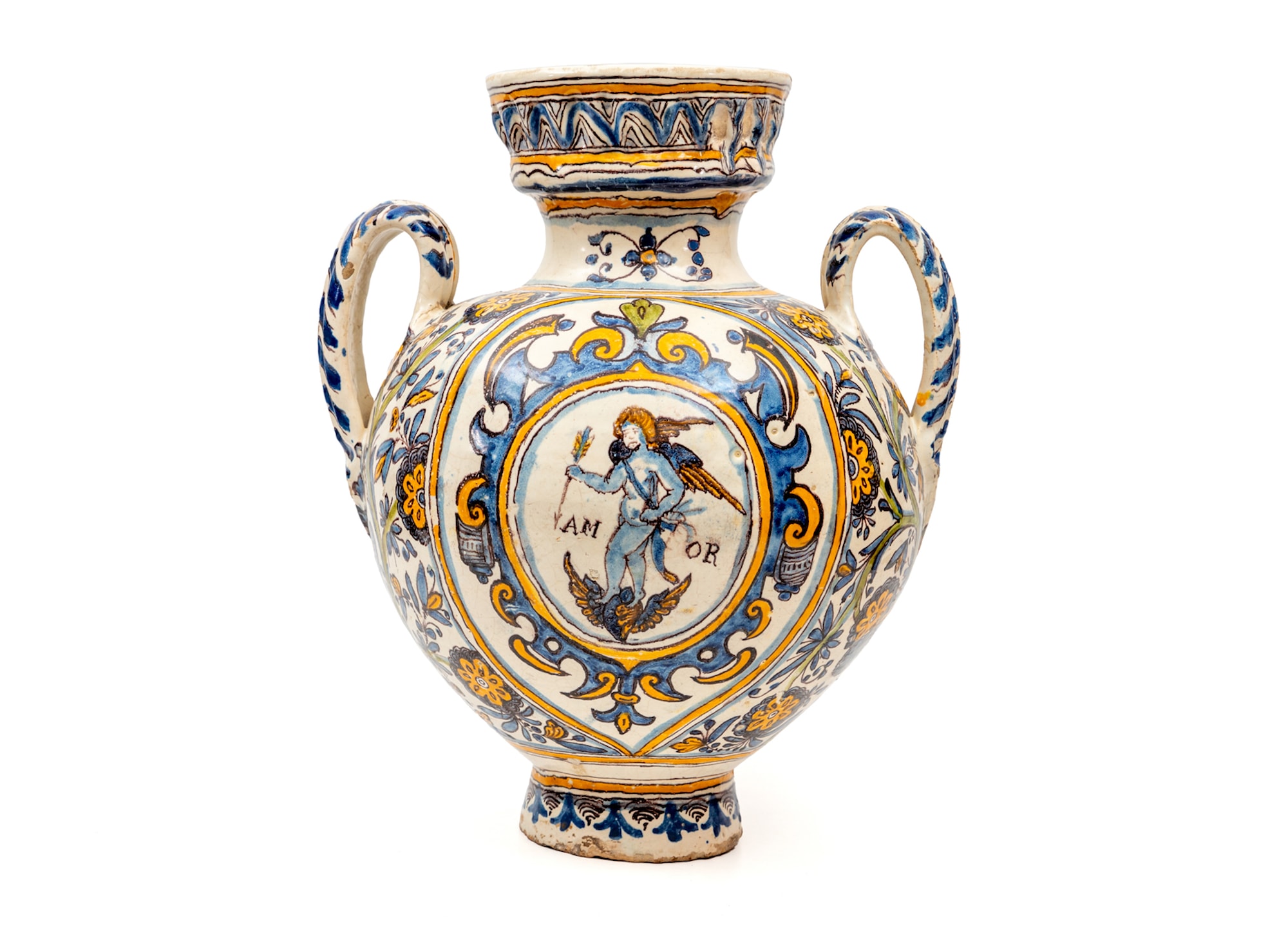
A two-handled 17th century portuguese faience urn
A two-handled 17th century portuguese faience urn
Date 1660–1680
Period 1660–1680
Origin Lisbon, Portugal
Medium Faience
Dimension 39.7 x 32 x 27 cm (15⁵/₈ x 12⁵/₈ x 10⁵/₈ inches)
Extraordinary wheel-thrown Portuguese faience urn dating from the second half of the 17th century, its shape defined by a bulbous body, large raising handles, elevated robust neck and elegantly scalloped flaring rim. The tin-white under glaze is unusually painted in bright polychrome pigments in an aesthetic grammar normally associated with decorative painted tiles of the same period.
The cobalt-blue and antimony-yellow glazes that cover most of the surface are complemented by small, carefully placed details in green, resulting from the mixing of the two pigments, and by the black outlining and filleting, a colour obtained by a high concentration of manganese pigment. This apparently irrelevant detail however, is the key for the quite specific dating timeframe of between 1660–1680.
Such short time span is supported by comparative studies with pieces of similar colour palette that were dated by the painter, and documented tile panels still in situ, namely at the gardens of the Marquess of Fronteira estate at São Domingos de Benfica in Lisbon that are known to date to between the late 1660’s and 1673.
The decorative language of this vase is particularly unusual; on each side of the body two heart shaped cartouches envelop a central roundel surrounded by a frame of Mannerist scrolls of clear Flemish flavour. In the centre, completing the composition, a gracious allegory of love; a Cupid carrying a bow and arrow is standing on a winged heart within the word ‘AMOR’ (LOVE). On the opposite surface a female figure holds a floral cornucopia, the Horn of Plenty, in a clear allusion to abundance.
A more unusual type of ornamentation can however be noticed in the denser patterns that were chosen to frame the handles. This type of exotic floral branches are not only present in the decoration of 17th century faience, but also in most contemporary tiled altar fronts generally defined as of ‘birds and foliage’, which attempt to fuse the simulation of textile altar fronts with the reinterpretation of textile and embroidery patterns from India and China.
Beneath the handles two naturalistic owls perched on branches, do surprise as the most original decorative detail of the whole composition.
Related depictions can be found in mid-17th century tiled altar fronts such as the ones at São Pedro Church in Almargem do Bispo (near Sintra) and Museu Nacional de Machado de Castro in Coimbra, this particular one depicting a Carmelite Emblem, as well as in some of the tile panels at the already referred Marquess of Fronteira estate gardens, which date from circa 1670.
A similar piece with styled cartouches encircling a vase with Franciscan insignia was illustrated by Artur de Sandão, a renowned historian and art collector[1].
Also, in the collection of the Count of Ameal, there existed a carving of analogous form, but decorated in blue and manganese, in “desenho míudo.” On the upper part of the body, it features, among other figures, a Cupid, accompanied by the inscription: “Não Quero Nada do Amor” (I Want Nothing from Love), in clear contrast with the inscription on our piece[2].
José Meco
Art Historian
[1] SANDÃO, Arthur, Faiança Portuguesa, Séculos XVIII e XIX, Vol. I, Livraria Civilização, p. 35
[2] Collections “Comte de Ameal” – Catalogue Descritif, Coimbra, 1921, Cat. 1105, pp. 78 e imagem 1105; QUEIRÓS, José, Cerâmica Portuguesa e Outros Estudos, Barcarena, Editorial Presença, 1907 (1ª edição), pp. 42 e 46, Gr. 22.
Date: 1660–1680
Period: 1660–1680
Origin: Lisbon, Portugal
Medium: Faience
Dimension: 39.7 x 32 x 27 cm (15⁵/₈ x 12⁵/₈ x 10⁵/₈ inches)
Provenance:
Literature: ‘Lisboa na Origem da Chinoiserie’, 2018, pp. 156–159
Exhibition: 'Un Siècle em BLanc et Bleu’, Galerie Mendes, Paris, 2016 (cat. p. 110–113)

São Roque
Fine Furniture, Silver, Portuguese Tiles and Ceramics, Arts of the Portuguese Expansion, Chinese Porcelain, Fine Arts
More artworks from the Gallery


