


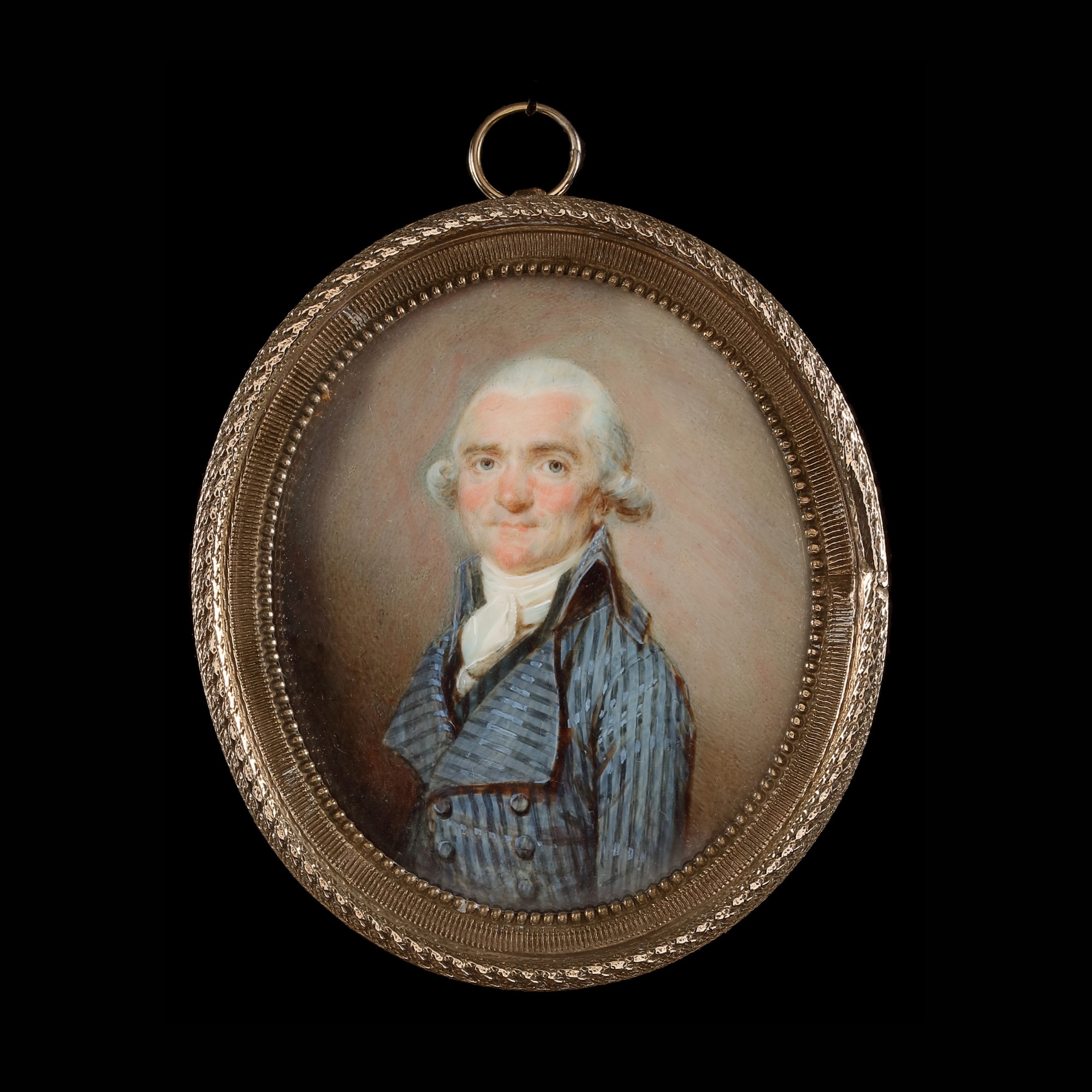
JEAN-BAPTISTE SOYER
Portrait miniature of a Gentleman in a blue ‘pékin’ coat, black waistcoat, and white stock and cravat
JEAN-BAPTISTE SOYER
Portrait miniature of a Gentleman in a blue ‘pékin’ coat, black waistcoat, and white stock and cravat
The Limner Company : Portrait Miniature
Date circa 1790s
Period Marie Antoinette, French Revolution
Origin France
Medium Watercolour on ivory
Dimension 5.8 cm (2¹/₄ inches)
Coats with high collars and large lapels, like that worn in this miniature, were popular in the 1790s. Though as the revolution progressed, silks came to be replaced with more humble cottons and wools, the fabric used to create this sitter’s coat combines the two materials, symbolising a shift from the extravagant materials used in Marie Antoinette’s court to the more sombre ones favoured by the revolutionaries. This type of fabric, which combines multiple materials, is called ‘pékin’. Similar coats are worn in two other miniatures by Soyer, both in the Tansey Foundation collection (10260 and 11149), though the rendering of the textures is certainly more advanced in the present example.
Date: circa 1790s
Period: Marie Antoinette, French Revolution
Origin: France
Medium: Watercolour on ivory
Dimension: 5.8 cm (2¹/₄ inches)
Provenance: Christie’s, 21 October 1997, lot 46;
Private collection.

The Limner Company : Portrait Miniature
Potrait miniatures from the 16/17th century, the 18th century and 19th century
More artworks from the Gallery
-Portrait oil of a Nobleman, wearing armour, fur-trimmed blue cap, white jabot and powdered wig_T639258409553312706.jpg?width=500&height=500&mode=pad&scale=both&qlt=90&format=jpg)

-Portrait miniature of Louis de Duras, 2nd Earl of Feversham (c.1641-1709), facing right in gilt-studded armour, lace_T639119431915240804.JPG?width=500&height=500&mode=pad&scale=both&qlt=90&format=jpg)
-Portrait enamel of a Lady, wearing pink and white dress with white underslip, her brown hair falling over her ri_T639258437250760077.jpg?width=500&height=500&mode=pad&scale=both&qlt=90&format=jpg)
