


ANTOINE VESTIER
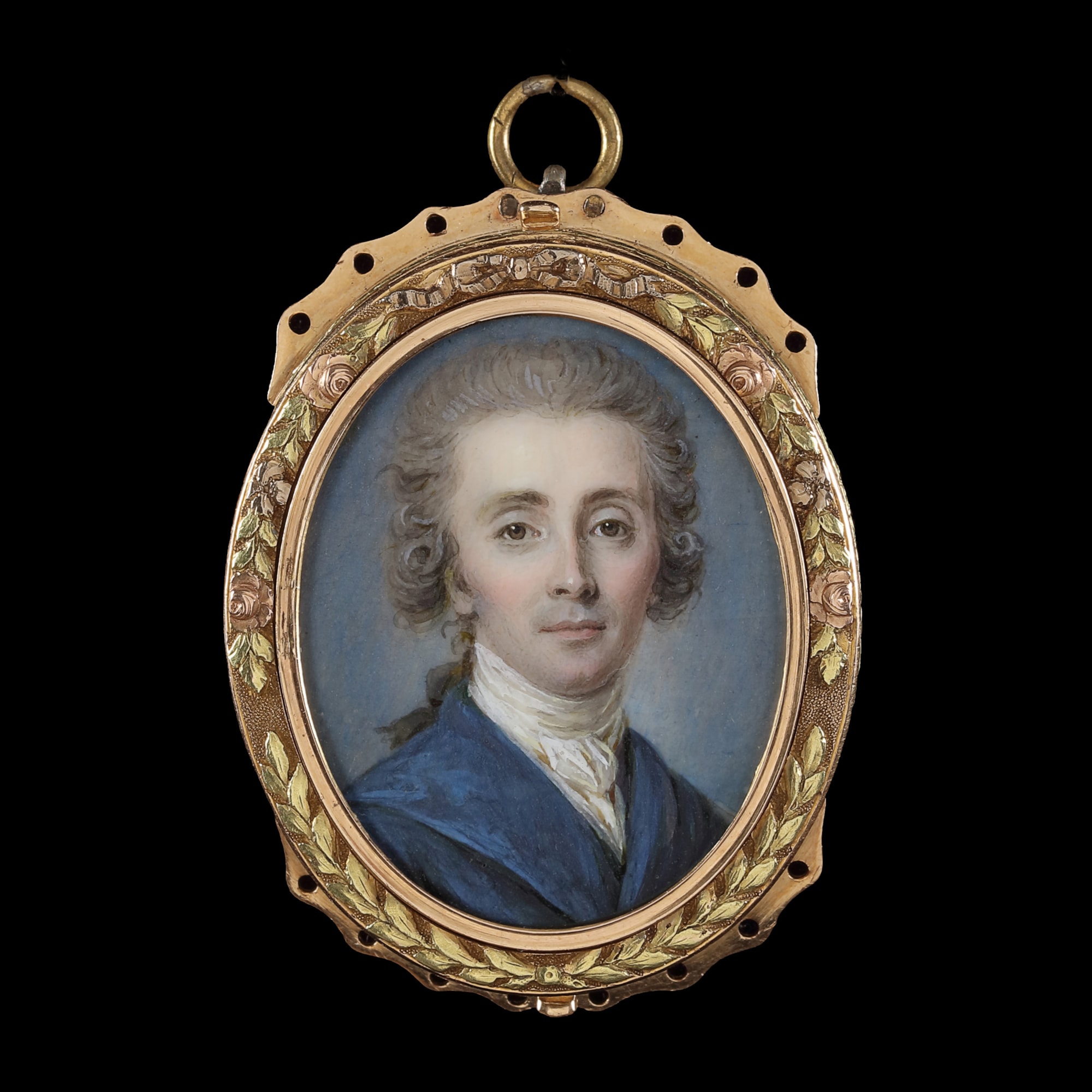
Portrait miniature of a Gentleman, wearing blue coat with a white stock, his hair powdered and worn 'en queue' with black solitaire
ANTOINE VESTIER
Portrait miniature of a Gentleman, wearing blue coat with a white stock, his hair powdered and worn 'en queue' with black solitaire
The Limner Company : Portrait Miniature
Date circa 1780s
Period Ancien Régime, Marie Antoinette
Origin France
Medium Watercolour on ivory
Dimension 3.3 cm (1¹/₄ inches)
Vestier’s most successful period was spent in France, where from the 1780s onwards he exhibited at the Salon de Correspondence (1782) and the Salon of the Louvre (from 1785). He was an associate, then a member, of the Académie Royale, and from there he was made painter to King Louis XVI (in 1788).
The gentleman in this portrait is anonymous, though his dress dates him to the latter half of the 1780s, when the overly elaborate styles of the 1770s had subsided, though before the more distinct and symbolic fashions of the 1790s (and therefore of the French Revolution).
By the time of the revolution, Vestier’s client base had thinned significantly, as aristocratic sitters had been forced to flee France, and it was difficult to find custom amongst revolutionaries, who were more likely to see miniature painting as an art form associated with the ancien régime. By the 1790s, he was struggling to support himself with the vocation, writing that “What I earn is just enough to live from hand to mouth … I paint for myself; the works will be sold as soon as possible.”. He continued to work and live well into the nineteenth century, however, and died in Paris on Christmas Eve in 1824.
[1] From a letter dated February 4, 1791, published in Passez, Anne-Marie. Adélaïde Labille-Guiard: Biographie et catalogue raisonné, Paris, 1973, p. 51.
Date: circa 1780s
Period: Ancien Régime, Marie Antoinette
Origin: France
Medium: Watercolour on ivory
Dimension: 3.3 cm (1¹/₄ inches)
Provenance: Private collection.

The Limner Company : Portrait Miniature
Potrait miniatures from the 16/17th century, the 18th century and 19th century
More artworks from the Gallery

, ‘Katherine of Aragon’ (1485-1536), ‘Anne Boleyn’ (c.1501-15_T639258442325460181.jpg?width=500&height=500&mode=pad&scale=both&qlt=90&format=jpg)
, Regent of the Banque de France (1801-1806)_T639195557891281981.JPG?width=500&height=500&mode=pad&scale=both&qlt=90&format=jpg)

, later John Bellenden Ker, wearing an Elizabeth style do_T639180834987532960.JPG?width=500&height=500&mode=pad&scale=both&qlt=90&format=jpg)
