JEAN-BAPTISTE JAQUES AUGUSTIN
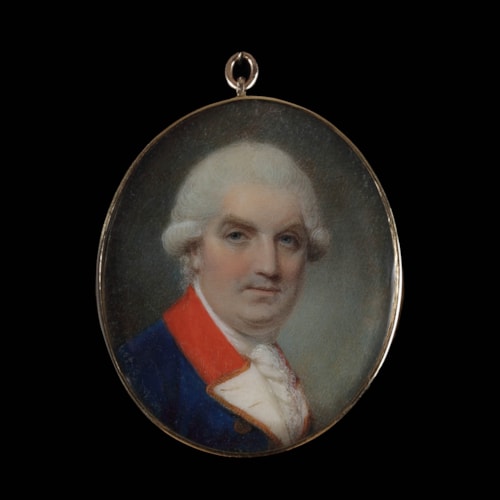
Portrait miniature of a Gentleman, traditionally called Charles-Maurice de Talleyrand-Périgord, wearing brown jacket with white shirt and stock, blue cape with red border, his hair powdered
JEAN-BAPTISTE JAQUES AUGUSTIN
Portrait miniature of a Gentleman, traditionally called Charles-Maurice de Talleyrand-Périgord, wearing brown jacket with white shirt and stock, blue cape with red border, his hair powdered
The Limner Company : Portrait Miniature
Date 1795
Epoque Napoleonic, French Revolution
Origine France
Medium Watercolour on ivory
Dimension 6.7 cm (2⁵/₈ inches)
Whereas most of the copies of this miniature are in a circular format, the present work is oval, setting it apart. It is possible that this version was the one commissioned by the sitter, and that the others were reproduced specifically to encourage practice within Augustin’s studio. There has been some debate over the identity of the sitter, who has traditionally been identified as Charles-Maurice de Talleyrand-Périgord. He began his career as a member of the French Clergy under Louis XVI (he was ordained in 1799), and famously switched sides during and after the French Revolution according to who had power at the time. As a result, he became known as the ‘Bishop of the Revolution’. Before being excommunicated in 1791, he left France and returned as a foreign minister in 1797, under the Directory. He resigned from this role soon after and returned to power in France as a close ally of Napoleon. After all this, he returned to King Louis XVIII’s council, as president, following the Restoration in France.
It is not surprising that such a figure, who moved across the world and across alliances so frequently, would have wanted a small, portable portrait to remind others of his appearance. However, there is no certain evidence that this is a portrait of Talleyrand. Though some of the features in this portrait and other known portraits of Talleyrand do exist (his hair, for example), these are not close enough to confidently identify the sitter.
Beginning his career slightly later than Talleyrand, Augustin had similarly dynamic loyalties. He became a painter for Napoleon, and later for Louis XVIII. He worked for Napoleon alongside Isabey, also known for his portraits of the emperor. Apart from his titles, Augustin was responsible for educating many young artists in miniature painting. Many of his students became recognised painters themselves. His skill for teaching is evident in the quality of the numerous copies of the present work.
[1] These are ‘copies by Villair (Christie's Geneva, November 9, 1976, no. 128), Verquelle (dated 1819, Christie's London October 14, 1998, no. 224), Ponsin (dated 1839, Sotheby's London, April 11, 1996, no. 147), and by anonymous miniaturists (Buchheit 1928, plate 19, no. 155).’ (taken from the cataloguing for Tansey Miniature Collection Inventory Number 10012, footnote 1, accessed online at https://tansey-miniatures.com/en/collection/10012)
Date: 1795
Epoque: Napoleonic, French Revolution
Origine: France
Medium: Watercolour on ivory
Signature: Signed and dated lower left 'Augustin 1795'
Dimension: 6.7 cm (2⁵/₈ inches)
Provenance: Possibly the collection of Mary Ethel Burns (niece of J.P. Morgan);
Private collection.

The Limner Company : Portrait Miniature
Potrait miniatures from the 16/17th century, the 18th century and 19th century
Plus d'œuvres d'art de la Galerie
 wearing blue coat with black collar, white lace cravat and pow_T639281925764273563.jpg?width=500&height=500&mode=pad&scale=both&qlt=90&format=jpg)

-Portrait miniature of a Gentleman, Mr ‘R’, wearing lilac coloured jacket_T639131490457651428.jpg?width=500&height=500&mode=pad&scale=both&qlt=90&format=jpg)
-Portrait of a Polish Noblewoman, wearing blue dress with gold embroidery and lace trim, a red cloak, her hair powd_T639131523904152408.jpg?width=500&height=500&mode=pad&scale=both&qlt=90&format=jpg)